
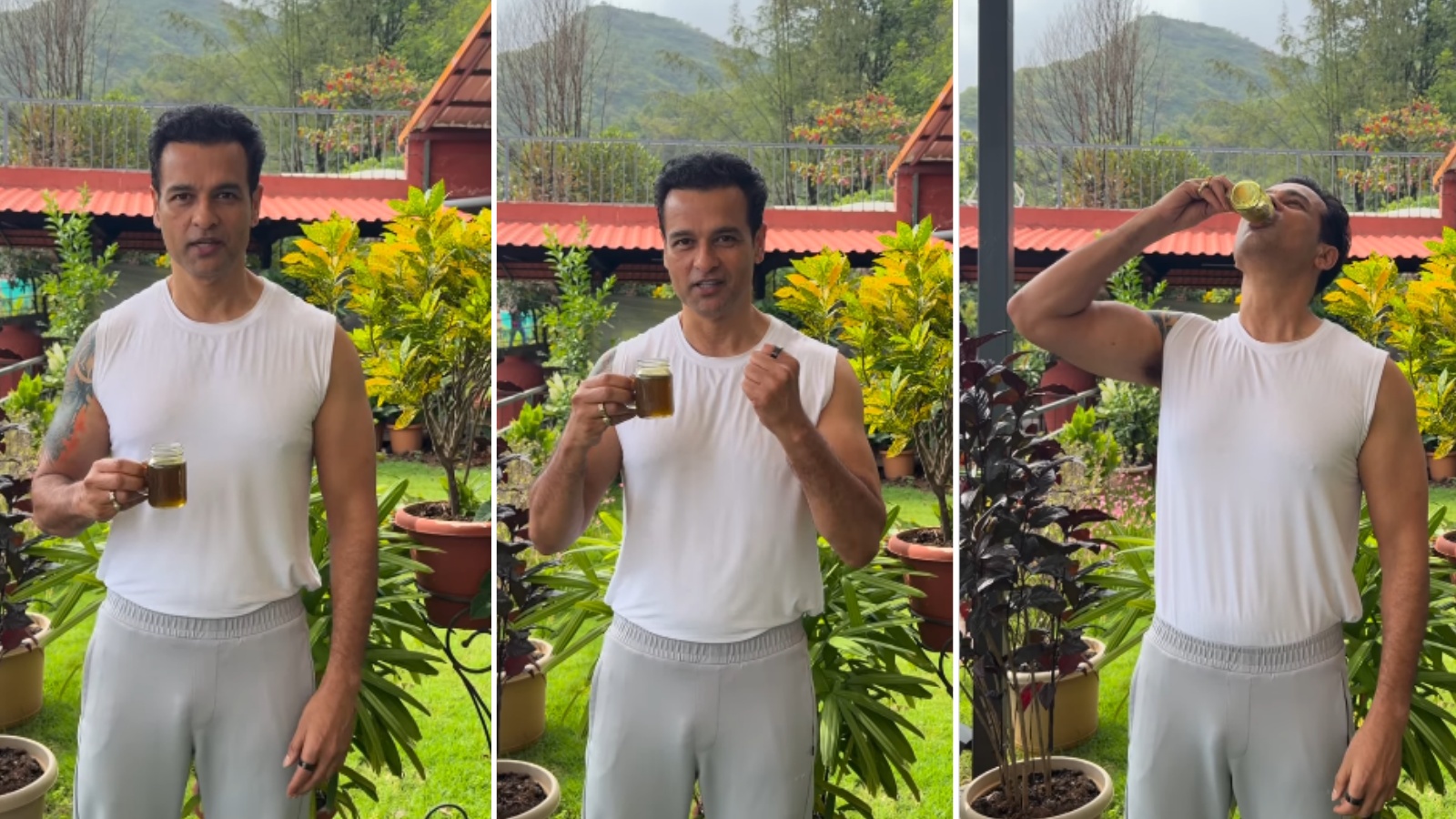
Chugging down a 150 ml ghee shot isn’t how most people imagine starting the day. But actor Rohit Roy did it with ease (and style) in his recent Instagram reel.
Before you jump to any conclusions, it was a part of his Panchakarma journey, and not another social media challenge.
“Day 5 at KARE Mulshi. Not 30 not 60 not 120, 150 ml of medicated ghee. But like Javed Akhtar says, dar ke aagey jeet hai,” he said before finishing the shot and winking at the camera.
The retreat also commented, “Welcome back Rohit! You chug ghee like a champ. 💪🏼 We love seeing how you embrace every step of the Panchakarma journey.” His elder brother, actor Ronit Bose Roy, also cheered him on, writing, “Good boy! Way to go 👍🏼.”
The video has sparked curiosity, but is drinking such a large amount of ghee actually safe?
DISCLAIMER: This article is based on information from the public domain and/or the experts we spoke to. Always consult your health practitioner before starting any routine.
Why do people drink medicated ghee during Panchakarma?
According to Dr Chetan Sharma, Senior Ayurveda Consultant, Aaryuvedam Hospital, Faridabad, drinking medicated ghee before Panchakarma is known as Snehapana or internal oleation. It is an important preparatory procedure before cleansing therapies such as Vamana ( (therapeutic emesis) and Virechana (therapeutic purgation), and is intended to prepare the body for these treatments.
“The primary objective is to loosen and mobilize accumulated doshas and metabolic toxins (Ama) from deeper tissues and channels towards the gastrointestinal tract, from where they can be eliminated through Panchkarma procedures,” he tells indianexpress.com.
Story continues below this ad
Dr Gagan Tiwari, MD, BAMS, Kailash Health Village, a unit of Kailash Healthcare, further explains that in Ayurveda, medicated ghee is believed to act as a Yogavahi, or a carrier that helps transport herbal ingredients deeper into the tissues. From a modern medical perspective, ghee is a fat-rich substance that can stimulate bile secretion and interact with fat metabolism.
However, he adds, “Panchkarma itself should be viewed as a whole therapeutic protocol, not just the simple habit of eating large quantities of ghee on its own.”
Why is it taken on an empty stomach?
Experts say Snehapana is never started without a detailed assessment.
Before prescribing medicated ghee, an Ayurvedic physician evaluates a person’s digestive strength (Agni), body constitution (Prakriti), disease condition, age and overall health. Patients are usually advised to eat light, easily digestible meals, avoid heavy, fried and processed foods and alcohol, and maintain a regular routine before therapy begins.
Story continues below this ad
The medicated ghee is generally consumed early in the morning on an empty stomach, after which the person’s digestion and tolerance are carefully monitored for “signs of digestion and tolerance throughout the process.”
This also explains why Rohit Roy was on Day 5 of the therapy. Experts say the quantity is often increased gradually over several days, depending on how well the previous day’s dose has been digested.
What does such a large amount of ghee do to the gut?
“When used appropriately as part of Panchkarma, it may help prepare the digestive system for subsequent therapies,” says Dr Shankar Zanwar, Senior Consultant Gastroenterologist, Gleneagles Hospital, Mumbai, also confirms.
However, it can also cause nausea, bloating, indigestion, loose stools and abdominal discomfort, particularly if the body does not tolerate it well.
Dr Sharma adds that the goal is not simply to consume fat but to support internal oleation, lubricate the gastrointestinal tract and improve the body’s response to Panchakarma.
Story continues below this ad
In Ayurveda, medicated ghee is believed to lubricate the body’s internal channels and help move accumulated doshas toward the gut before the main cleansing process (Image: Unsplash)
Is 150 ml safe for everyone?
The simple answer is no. All three experts sternly clarify that there is no standard dose of medicated ghee and the practice is “certainly not suitable for everyone.”
The quantity depends on several factors, including digestive capacity, body constitution, age, body weight, disease condition, bowel habits and treatment goals.
“While the therapy is going on, the practitioner keeps looking for little signals that tell whether the body is taking it in an okay and proper way,” Dr Tiwari assures.
If the person experiences ongoing nausea, vomiting, really strong abdominal pain or just general discomfort or diarrhoea, or if the body just can’t properly digest the ghee, then the whole regimen may need a rethink.
Story continues below this ad
“In some cases it should even be stopped before it turns into something else worse, because otherwise the effects can get out of hand pretty fast,” Dr Tiwari further warns.
“Consuming 150 ml without supervision may not be safe and can be excessive for many people,” Dr Shankar Zanwar, Senior Consultant Gastroenterologist, Gleneagles Hospital, Mumbai also cautions.
Should you try this after watching a social media reel?
Experts strongly advise against it. “Snehapana is a therapeutic procedure and not a wellness trend,” says Dr Sharma.
The medicated ghee, dosage, duration, dietary restrictions and monitoring are individualised. Self-administering large quantities after watching social media videos can lead to digestive disturbances and may even worsen underlying health conditions.
Story continues below this ad
Dr Zanwar echoes this and warns that regularly consuming such large amounts of ghee without medical advice may contribute to excess calorie intake, weight gain and digestive disturbances.
Excessive intake may also cause diarrhoea, nausea and acidity, aggravate gallbladder or pancreatic conditions in vulnerable individuals, and long-term high intake of saturated fat may also affect cholesterol levels in some people.
People with gallbladder disease, pancreatitis, severe liver disease, obesity or uncontrolled metabolic disorders should avoid self-medicating with large quantities of ghee unless advised by a qualified physician.
“There is limited high-quality scientific evidence to support claims that medicated ghee alone detoxifies the body or significantly improves gut health,” says Dr Zanwar. More well-designed clinical studies are needed, and current evidence does not support self-prescribing this practice for general health.
While Rohit Roy’s 150 ml ghee shot has caught social media’s attention, experts emphasise that it is part of a carefully supervised Panchakarma programme. It is not a practice to copy at home simply because it worked for someone else.
DISCLAIMER: This article is based on information from the public domain and/or the experts we spoke to. Always consult your health practitioner before starting any routine.