
5 min readNew DelhiJul 25, 2026 12:00 PM IST
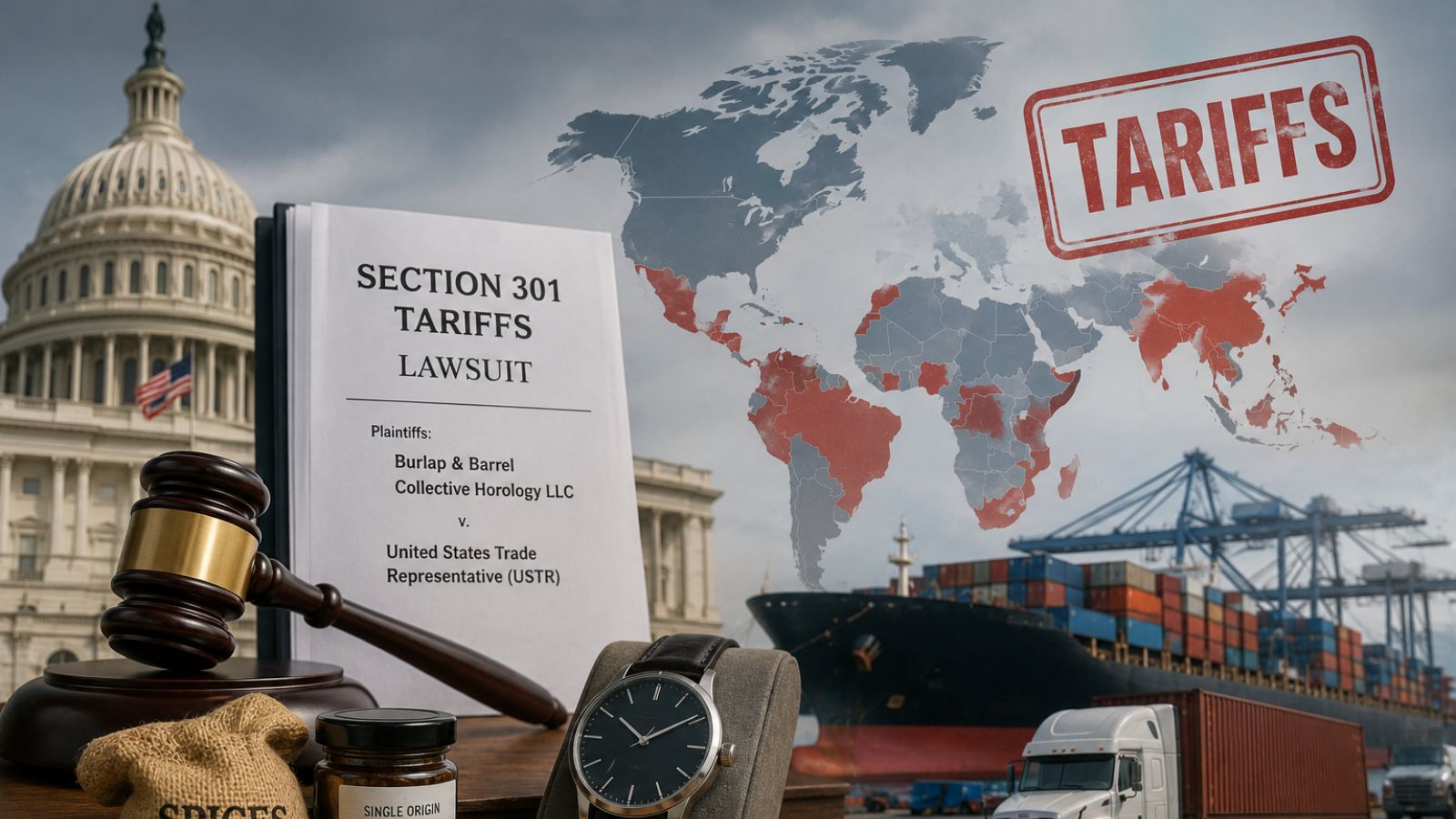
A day after US imposed fresh tariffs on 60 countries including 10% duty on India, two US small businesses – Burlap & Barrel, spice importer and Collective Horology LLC, a watch retailer – have filed a case against United States Trade Representative (USTR) for the use of Section 301 to impose tariffs impacting “99.4% of all imports into the United States”, case documents have shown.
This assumes particular significance for India, as New Delhi has committed to a US trade deal but has yet to sign it formally. Government officials say that India is willing to sign the deal when the new US architecture gives India a competitive edge compared to its competitors in the Association of Southeast Asian Nations (ASEAN) region – one of the fastest growing regions globally. US had opened two Section 301 investigations, one on ‘excess capacity’ and the other on ‘forced labour’.
The small business argued that USTR failed to provide a “reasoned, record-based explanation for its determinations or for its selection of near-uniform duties” across 60 economies with materially different enforcement records and trade profiles. They argue that if Section 301 were interpreted to allow such broad power, it would constitute an unconstitutional delegation of Congress’s Article I power to lay duties.
“The Section 122 tariffs were limited by statute to 150 days. The administration used that period to conduct the Section 301 investigations at issue here and then imposed the challenged Section 301 tariffs. The sequence and structure of those measures, as well as Administration statements, show that the Section 301 Action was designed to preserve substantially the same broad tariff regime that this Court and the Supreme Court have held Congress did not authorise under IEEPA and Section 122,” the small businesses argued.
The US has imposed Section 122 tariffs, imposing 10% tariffs globally immediately after losing the IEEPA case in the US Supreme Court. India faced steep 50% tariffs for over 5 months. In 2025-26, exports of products covered under the exclusion list [electronics and pharma] rose sharply by 24.5%, climbing from $29.4 billion to $36.6 billion but exports of non-excluded products fell by 11.2% over the same period, declining from $57.1 billion to $50.7 billion – a contraction that reflects the true effect of the tariff measures imposed by the United States, an Indian Council for Research on International Economic Relations (ICRIER) report said.
“The Section 301 action exceeds the authority Congress granted in Section 301. Section 301 is a targeted, country-specific and practice-specific remedial authority. It permits the Trade Representative to act only upon a determination that a particular act, policy, or practice of a foreign country is unreasonable or discriminatory and burdens or restricts United States commerce… It is not a freestanding authorisation to tax substantially all imports from substantially all trading partners at rates selected to replicate the invalidated IEEPA tariff regime rather than to eliminate identified foreign practices,” US small business argued.
Experts have said that Section 301 is a far more potent tool than the International Emergency Economic Powers Act (IEEPA) tariffs, which were used to impose reciprocal tariffs but did not pass muster in the US Supreme Court. This legal tool was mostly used by the US against countries such as Europe & Japan, dominant export powers then, before the WTO came into existence in 1995. The Trump administration has resurrected Section 301 again amid a weakening WTO.
Story continues below this ad
Singapore-based Henrich Foundation explained that under Section 301, USTR gets sweeping powers not only to impose duties but also other kinds of restrictions. USTR can “withdraw or suspend trade agreement concessions”, enter into binding agreements with the foreign government to eliminate the conduct or unburden US commerce, or compensate the US with satisfactory trade benefits.
“After consultations, USTR is meant to investigate to determine whether the action is unfair and harms US trade. This investigation can result in a determination of either mandatory or discretionary actions. The former includes trade agreement violations, unjustifiable or burdensome, or restrictive behaviour. Because Section 301 need not apply only to goods, other retaliatory actions are allowed, such as restricting the terms or conditions or denying the issuance of any ‘service sector access authorisation, ’ the Henrich Foundation report said.
Deborah Elms, Head of Trade Policy at Hinrich Foundation, had said that Section 301 could have a firmer legal standing and tariffs imposed could reach any level as long as the required procedures are followed. USTR started the investigation in March and has come out with the findings after the required duration. It has also allocated time for public comments.
“The courts, if asked to examine the use of Section 301, are likely to give the President wide deference as long as the required procedures are followed. Recall that the law provides maximum timelines, not any minimum. Past cases were often narrowly targeted. Future cases need not be so constrained. Tariffs may be part of any retaliatory package, set to any level, alongside a wide range of other actions to address the charge of unfair trade practices,” Elms said.