
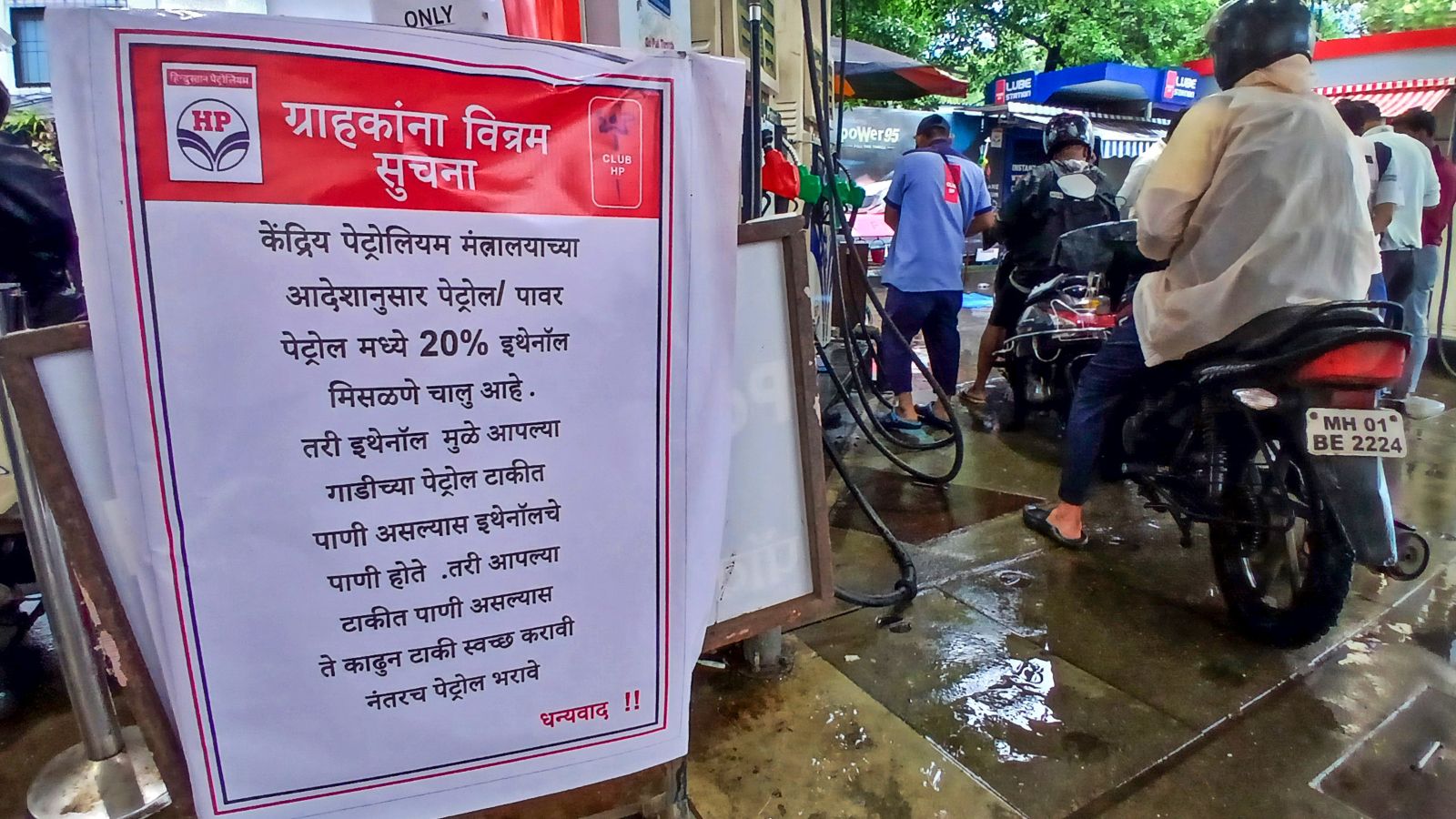
Countering criticism over its ethanol blended petrol programme, the government on Friday said while the current base fuel E20 — 80% petrol, 20% ethanol — can reduce fuel economy in some vehicles by 3-5%, it is cleaner and superior in other performance parameters vis-a-vis pure petrol and lower ethanol-petrol blends.
On consumers not getting the option to choose between pure petrol and ethanol-blended petrol of different blend levels, the government said that offering multiple grades of base fuel across the country would create an “enormous logistical challenge”, apart from raising costs and reducing operational efficiency in the complex fuel retail network.
The government also argued that achieving 20% ethanol blending levels required massive investments, and going back to a lower blend level would not be prudent on various counts. India achieved 20% ethanol blending in petrol last year and the E20 fuel is currently the standard petrol variant across the country.
There has been public backlash over the E20 fuel, with claims ranging from reduction in mileage to engine component wear and tear in older vehicles whose engines were not designed for higher ethanol blends.
The government has been attempting to allay such fears, saying that the drop in mileage in older vehicles would be marginal, outweighed by benefits like higher octane rating, superior anti-knock characteristics, faster combustion, better pickup, smoother acceleration and cleaner engine operation. The government has also rejected claims that E20 fuel could damage engine components.
As reported on Friday, Union Road Transport and Highways Minister Nitin Gadkari had told The Indian Express that reports of vehicular damage being circulated on social media were “overblown” and part of a concerted “false narrative”. He had said that while average mileage could dip as ethanol content increases, the West Asian crisis has shown that India must explore all alternatives to fossil fuel imports.
There have also been questions on why consumers were not being offered a choice between pure petrol, E10 and E20 fuels, as is the practice in some countries.
Story continues below this ad
“…if a cleaner, faster and less-polluting fuel is available, why would we deliberately choose an inferior alternative? The suggestion that every petrol pump should stock pure petrol, E10 and E20 simultaneously also ignores the realities of India’s fuel distribution network. India operates over one lakh retail outlets, supported by an extensive network of refineries, terminals, depots and pipelines. Maintaining multiple grades of base petrol across this vast supply chain would create an enormous logistical challenge, increase handling costs, complicate inventory management and reduce operational efficiency,” the Petroleum Ministry said in a detailed note on Friday.
“Over the past several years, public sector banks have financed nearly Rs 1 lakh crore/yr of investments in ethanol production and associated infrastructure…If, after creating this capacity, we were to arbitrarily revert to E10, what happens to these investments? What happens to the surplus production capacity? What happens to thousands of crores invested by farmers, cooperatives, entrepreneurs, financial institutions and public sector companies in good faith based on a national policy? Public policy must balance consumer interest with energy security, environmental sustainability, farmer welfare and prudent use of national resources,” the ministry said.
Seeking to dismiss concerns that ethanol blending in petrol was accelerated in haste, the ministry said the rollout was not based “on assumptions”, but done after detailed consultations with automobile manufacturers and other stakeholders, and extensive testing and field validation covering engine durability, fuel systems, material compatibility, corrosion resistance, drivability, emissions and performance.
However, following the backlash, there are indications that introduction of higher blends of ethanol in petrol may be delayed by the government. On Tuesday, The Indian Express had reported that the government was likely to push back the proposed shift to E25 fuel.
Story continues below this ad
In its note on Friday, the ministry reiterated that the ethanol-petrol blending programme dates back over two decades, and “nobody questioned ethanol as a fuel”, given its use in various countries, including the US and Brazil. After languishing for about a decade, India’s ethanol blending programme gathered pace over the past few years as the government made concerted efforts to ensure sufficient ethanol availability.
“When India decided to move towards higher ethanol blends, the automobile industry was involved at every stage. For E10 compatibility, manufacturers were consulted well in advance, as early as 2020-21. India achieved its E10 target in June 2022… For E20, an even more rigorous process was followed. Extensive consultations were held with automobile manufacturers, component suppliers, testing agencies and research institutions. The roadmap of the IMC (Inter-Ministerial Committee) had been in the public domain from 2021 and laid out a calibrated path to reaching E20,” the ministry said.
“Had automobile manufacturers not been fully satisfied with the results, they would never have stood behind the product or honoured vehicle warranties. The fact that virtually every manufacturer today is honouring warranty for all vehicles (old or new) is because they have been part of the consultation. Further, Maruti Suzuki serviced 2.84 crore vehicles during FY 2025-26, including 1.5 crore older, non-E20-certified vehicles, and reported no E20-linked corrosion, abnormal wear or component-life damage. Hero MotoCorp has reported similar field experience. This real-world evidence is far more reliable than isolated anecdotes,” it said.
According to the ministry, if E20 was damaging rubber components, fuel lines or engines, there would have been lakhs of warranty claims by vehicle owners, widespread component failures, and an avalanche of complaints across the country, which “has simply not happened”. The government also assured that the ethanol supply chain is among the most tightly regulated fuel supply systems, and that ethanol and blended petrol conform to strict Bureau of Indian Standards (BIS) specifications and undergo quality checks at every stage from the “distillery to the depot to the retail outlet”.
Story continues below this ad
“E20 is a safe, cleaner, proven and scientifically validated fuel that Indian consumers can use with confidence. Its quality, safety and compatibility have been validated and assured by all responsible stakeholders, including automobile manufacturers, testing and homologation agencies, oil marketing companies, and regulatory authorities. Consumers are therefore advised not to be misled by misinformation, scaremongering or unverified content circulating on social media,” it said.
On pricing, the ministry said E20 is not necessarily cheaper because ethanol procurement prices are fixed at remunerative levels to support farmers and can exceed the cost of petrol when international crude prices are relatively low.