
3 min readNew DelhiJul 20, 2026 06:38 PM IST
The commerce ministry’s revised Index of Core Industries (ICI) surged to a five-month high of 5% in June. The inclusion of iron ore as the ninth sector was instrumental as its output was 43.9% higher compared to June 2025, according to data released Monday, with a low base effect responsible for this outsized rate of growth.
The new core sector data series – which has 2022-23 as the base year as against 2011-12 in the old one – continues the government’s overhaul of India’s official statistics. So far in 2026, the statistics and commerce ministries have already released updated data series for GDP, Consumer Price Index, Index of Industrial Production, Wholesale Price Index as well as the inaugural Output Producer Price Index and trial numbers for input PPI and an Index of Services Production.
The new data series downgrades core sector growth in 2024-25 sharply to 4.3% from 6.9%. However, it has upgraded the figure for 2025-26 to 3% from 1.1%.
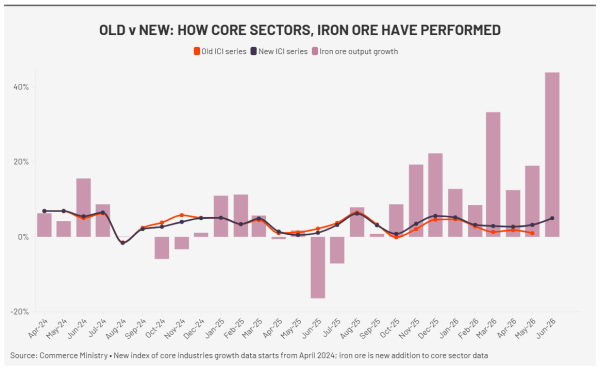 Core Sector Data Chart
While iron ore only makes up 4.9% of the new Index of Core Industries, the 43.9% jump in its production in June was key to the entire core sector output rising the most in five months. The growth for May has been revised higher to 3.2% in the new series from a 1% under the old series.
Iron ore, whose output is estimated to have risen by 19% in May, has been added to the index due to its extensive industry use and significant contribution to industrial development.
The other eight sectors part of the ICI are coal, crude oil, natural gas, refinery products, fertilisers, steel, cement, and electricity.
Some of the other key changes in the revised core sector data include the use of gross production data for compiling the steel index, the coal index including only ‘raw coal’ and not coal middlings and washed coal to eliminate double counting, among others.
Story continues below this ad
Apart from iron ore, core sector growth in June was driven by a 9.8% rise in electricity generation, with the high temperatures and rainfall deficit boosting demand for power. The same sub-par monsoon helped raise coal output by 1.4% after three consecutive months of decline.
Mining activity is disrupted by rains.
Steel output rose 4.6%, while cement production was up 9.8%.
Meanwhile, petroleum-related sectors all reported a fall in production in June compared to last year, which Madan Sabnavis, Chief Economist at Bank of Baroda, said can be attributed to higher imports on account of global crude prices declining.
“Export of refinery products had slowed down this month. In case of fertilisers imports tended to increase,” Sabnavis said.
Crude oil fell for the 18th month in a row in June and was down 4.2% year-on-year.
Story continues below this ad
Natural gas output (down 7.4%) contracted for the 24th consecutive month.
Refinery products (down 4.7%) saw their production shrink for the third month in a row.
Prodcution of fertilisers (down 3.3%) was lower for the fourth straight month.